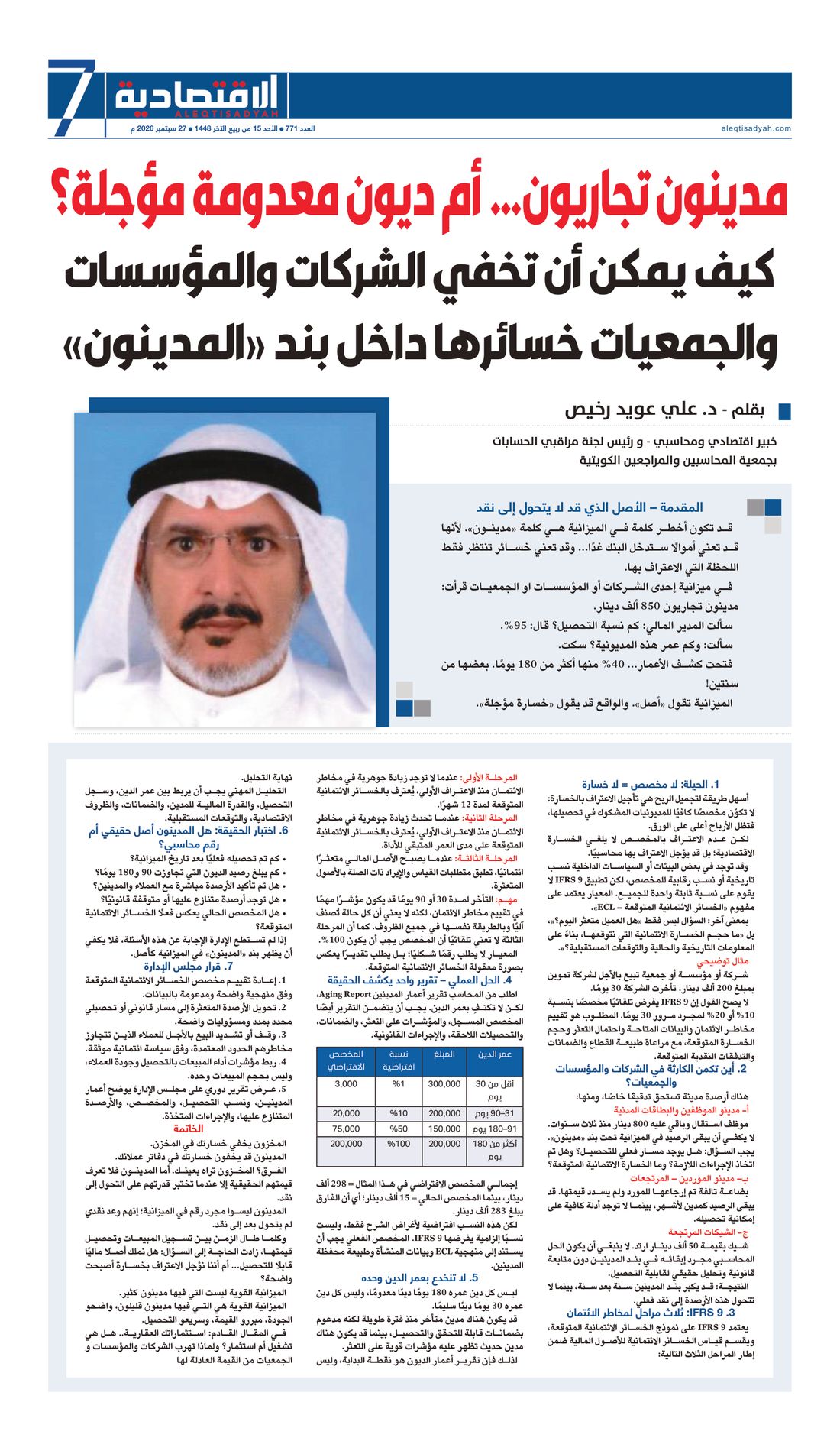


Introduction – The asset that may never turn into cash
The most dangerous word on the balance sheet may well be “receivables”. Because it may mean money that will reach the bank tomorrow… or it may mean losses that are merely waiting for the moment they are recognised.
On the balance sheet of a company, establishment or society, I read: trade receivables, KD 850,000. I asked the finance manager: what is the collection rate? He said: 95%. I asked: and how old is this debt? He fell silent. I opened the ageing schedule… 40% of it was more than 180 days old. Some of it went back two years!
The balance sheet says “asset”. Reality may say “deferred loss”.
1. The trick: no allowance = no loss
The easiest way to flatter profit is to defer recognition of the loss: you do not set up an adequate allowance for doubtful debts, so profits stay higher on paper. But failing to recognise the allowance does not cancel the economic loss; it may simply defer its recognition in the accounts.
In some environments or internal policies there may be historical rates or regulatory rates for the allowance, but the application of IFRS 9 does not rest on one fixed rate for everyone. The standard is based on the concept of “expected credit losses – ECL”. In other words: the question is not only “Is the customer in default today?” but “What is the size of the credit loss we expect, based on historical and current information and forward-looking expectations?”.
Illustrative example
A company, establishment or society sells on credit to a catering supplies company for KD 200,000. The company is 30 days late. It is not correct to say that IFRS 9 automatically imposes an allowance of 10% or 20% merely because 30 days have passed. What is required is an assessment of credit risk, the available data, the probability of default and the size of the expected loss, taking into account the nature of the sector, collateral and expected cash flows.
2. Where does the disaster lie in companies, establishments and societies?
There are receivable balances that deserve special scrutiny, among them:
A – Employee receivables and civil ID cards
An employee resigned and has still owed KD 800 for three years. It is not enough for the balance to stay on the balance sheet under “receivables”. The questions must be asked: is there an actual route to collection? Have the necessary steps been taken? And what is the expected credit loss?
B – Supplier receivables – returns
Damaged goods were returned to the supplier, who has not paid their value. The balance may remain as a receivable for months, while there is insufficient evidence that it can be collected.
C – Returned cheques
A cheque for KD 50,000 bounced. The accounting answer should not be simply to leave it in the receivables line without legal follow-up and a genuine analysis of collectability.
The result: the receivables line may grow year after year, while these balances do not turn into actual cash.
3. IFRS 9: three stages of credit risk
IFRS 9 is based on the expected credit loss model, and divides the measurement of credit losses on financial assets within the framework of the following three stages:
- Stage 1: when there is no significant increase in credit risk since initial recognition, 12-month expected credit losses are recognised.
- Stage 2: when a significant increase in credit risk has occurred since initial recognition, expected credit losses are recognised over the remaining life of the instrument.
- Stage 3: when the financial asset becomes credit-impaired, the measurement and revenue requirements relating to credit-impaired assets apply.
Important: a delay of 30 or 90 days may be an important indicator in assessing credit risk, but it does not mean that every case is classified mechanically and in the same way in all circumstances. Nor does Stage 3 automatically mean that the allowance must be 100%. The standard does not ask for a token figure; it asks for an estimate that reasonably reflects expected credit losses.
4. The practical solution – one report that reveals the truth
Ask the accountant for the receivables ageing report (Aging Report), but do not stop at the age of the debt. The report must also include the recorded allowance, indicators of default, collateral, subsequent collections and legal action.
| Age of debt | Amount | Assumed rate | Assumed allowance |
|---|---|---|---|
| Less than 30 days | 300,000 | 1% | 3,000 |
| 31–90 days | 200,000 | 10% | 20,000 |
| 91–180 days | 150,000 | 50% | 75,000 |
| More than 180 days | 200,000 | 100% | 200,000 |
The total assumed allowance in this example = KD 298,000, while the current allowance = KD 15,000; that is, the difference amounts to KD 283,000. But these rates are assumed for the purposes of illustration only; they are not mandatory rates imposed by IFRS 9. The actual allowance must be based on an ECL methodology, the entity’s own data and the nature of the receivables portfolio.
5. Do not be fooled by the age of the debt alone
Not every debt that is 180 days old is a bad debt, and not every debt that is 30 days old is a sound one. There may be a debtor who has been overdue for a long time but is backed by collateral that can be realised and collected, while there may be a recent debtor showing strong signs of default.
The debt ageing report is therefore the starting point, not the end of the analysis. Professional analysis must connect the age of the debt, the collection record, the debtor’s financial capacity, collateral, economic conditions and forward-looking expectations.
6. The truth test: are receivables a real asset or an accounting number?
- How much has actually been collected after the balance sheet date?
- What is the balance of debts that have passed 90 and 180 days?
- Have the balances been confirmed directly with customers and debtors?
- Are there balances that are in dispute or legally stalled?
- Does the current allowance truly reflect expected credit losses?
If management cannot answer these questions, it is not enough for the “Receivables” line to appear on the balance sheet as an asset.
7. The board of directors’ resolution
- Reassess the allowance for expected credit losses under a clear, data-supported methodology.
- Move defaulted balances onto a defined legal or collection track with clear time limits and responsibilities.
- Stop or tighten credit sales to customers whose risk exceeds the approved limits, under a documented credit policy.
- Link sales performance indicators to collection and customer quality, not to sales volume alone.
- Present a periodic report to the board of directors showing receivables ageing, collection rates, the allowance, disputed balances and the action taken.
Conclusion
Inventory hides your loss in the warehouse. Receivables may hide your loss in your customers’ books. The difference? Inventory you can see with your own eyes. Receivables are another matter: you do not know their true value until you test their ability to turn into cash.
Receivables are not just a number on the balance sheet; they are a promise of cash that has not yet turned into cash. And the longer the time between recording the sales and collecting their value, the greater the need to ask: do we hold a collectable financial asset… or are we deferring recognition of a loss that has become plain?
A strong balance sheet is not one with many receivables. A strong balance sheet is one with few receivables: clear in quality, justified in value and quick to collect.
In the next article: your property investments.. are they operating or investment? And why do companies, establishments and societies run from their fair value?