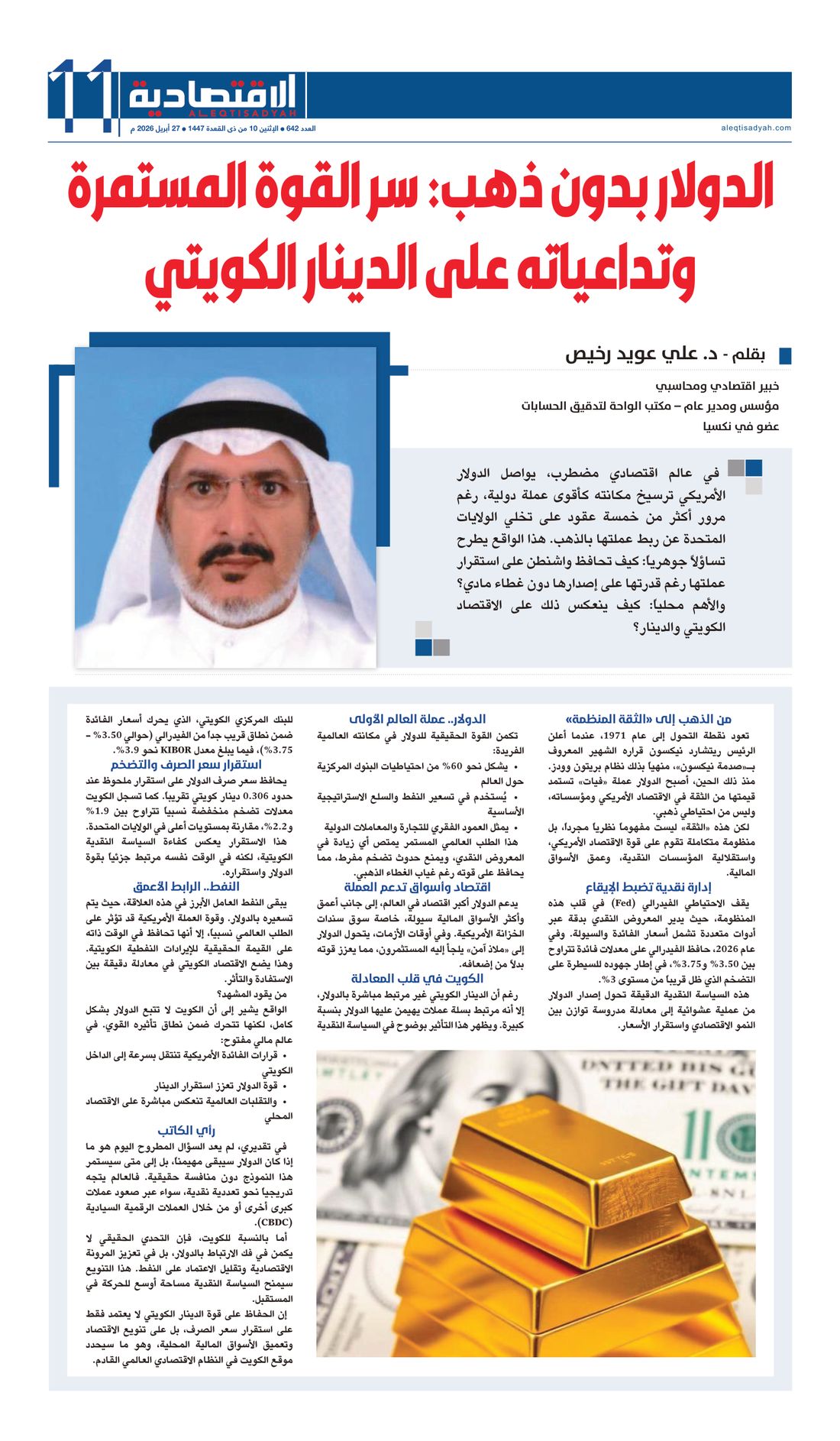


In a turbulent economic world, the US dollar continues to cement its position as the strongest international currency, even though more than five decades have passed since the United States abandoned the link between its currency and gold. This reality raises a fundamental question: how does Washington maintain the stability of its currency despite its ability to issue it without physical backing? And, more importantly at home: how does this feed through to the Kuwaiti economy and the dinar?
From Gold to “Organised Trust”
The turning point dates back to 1971, when President Richard Nixon announced his famous decision known as the “Nixon shock”, thereby bringing the Bretton Woods system to an end. Since then, the dollar has been a “fiat” currency that derives its value from trust in the US economy and its institutions, and not from a gold reserve. But this “trust” is not an abstract theoretical concept; rather, it is an integrated system that rests on the strength of the US economy, the independence of the monetary institutions and the depth of the financial markets.
Monetary Management That Sets the Tempo
The Federal Reserve (Fed) stands at the heart of this system, managing the money supply with precision through multiple tools that include interest rates and liquidity. In 2026, the Fed kept interest rates in a range of between 3.50% and 3.75%, as part of its efforts to bring under control inflation that remained close to the 3% level. This precise monetary policy turns the issuance of the dollar from a haphazard process into a calculated equation that balances economic growth against price stability.
The Dollar: the World’s Number One Currency
The real strength of the dollar lies in its unique global standing:
- It accounts for around 60% of the reserves of central banks around the world
- It is used in the pricing of oil and essential strategic commodities
- It represents the backbone of international trade and transactions
This continuous global demand absorbs any increase in the money supply and prevents excessive inflation from occurring, which preserves the dollar’s strength despite the absence of gold backing.
An Economy and Markets That Support the Currency
The dollar is backed by the largest economy in the world, alongside the deepest and most liquid financial markets, in particular the US Treasury bond market. In times of crisis, the dollar turns into a “safe haven” to which investors resort, which reinforces its strength rather than weakening it.
Kuwait at the Heart of the Equation
Although the Kuwaiti dinar is not pegged directly to the dollar, it is pegged to a basket of currencies that is dominated to a large extent by the dollar. This influence shows clearly in the monetary policy of the Central Bank of Kuwait, which moves interest rates within a range very close to that of the Fed (around 3.50% – 3.75%), while the KIBOR rate stands at around 3.9%.
Exchange Rate Stability and Inflation
The dollar exchange rate maintains notable stability in the region of approximately KD 0.306. Kuwait also records relatively low inflation rates, ranging between 1.9% and 2.2%, compared with higher levels in the United States. This stability reflects the efficiency of Kuwaiti monetary policy, but at the same time it is partly linked to the strength and stability of the dollar.
Oil: the Deepest Link
Oil remains the most prominent factor in this relationship, as it is priced in dollars. The strength of the US currency may affect global demand to some degree, yet at the same time it preserves the real value of Kuwait’s oil revenues. This places the Kuwaiti economy in a delicate equation between benefiting and being affected.
Who is in the driving seat? The reality indicates that Kuwait does not follow the dollar completely, but it does move within the range of its powerful influence. In an open financial world:
- US interest rate decisions are transmitted quickly to the Kuwaiti domestic scene
- The strength of the dollar reinforces the stability of the dinar
- And global fluctuations are reflected directly in the local economy
The Author’s View
In my assessment, the question being asked today is no longer whether the dollar will remain dominant, but rather how long this model will continue without real competition. The world is moving gradually towards monetary plurality, whether through the rise of other major currencies or through sovereign digital currencies (CBDC).
As for Kuwait, the real challenge lies not in decoupling from the dollar, but in strengthening economic resilience and reducing dependence on oil. This diversification will give monetary policy wider room for manoeuvre in the future. Preserving the strength of the Kuwaiti dinar does not depend solely on exchange rate stability, but on diversifying the economy and deepening the local financial markets, and that is what will determine Kuwait’s position in the coming global economic order.