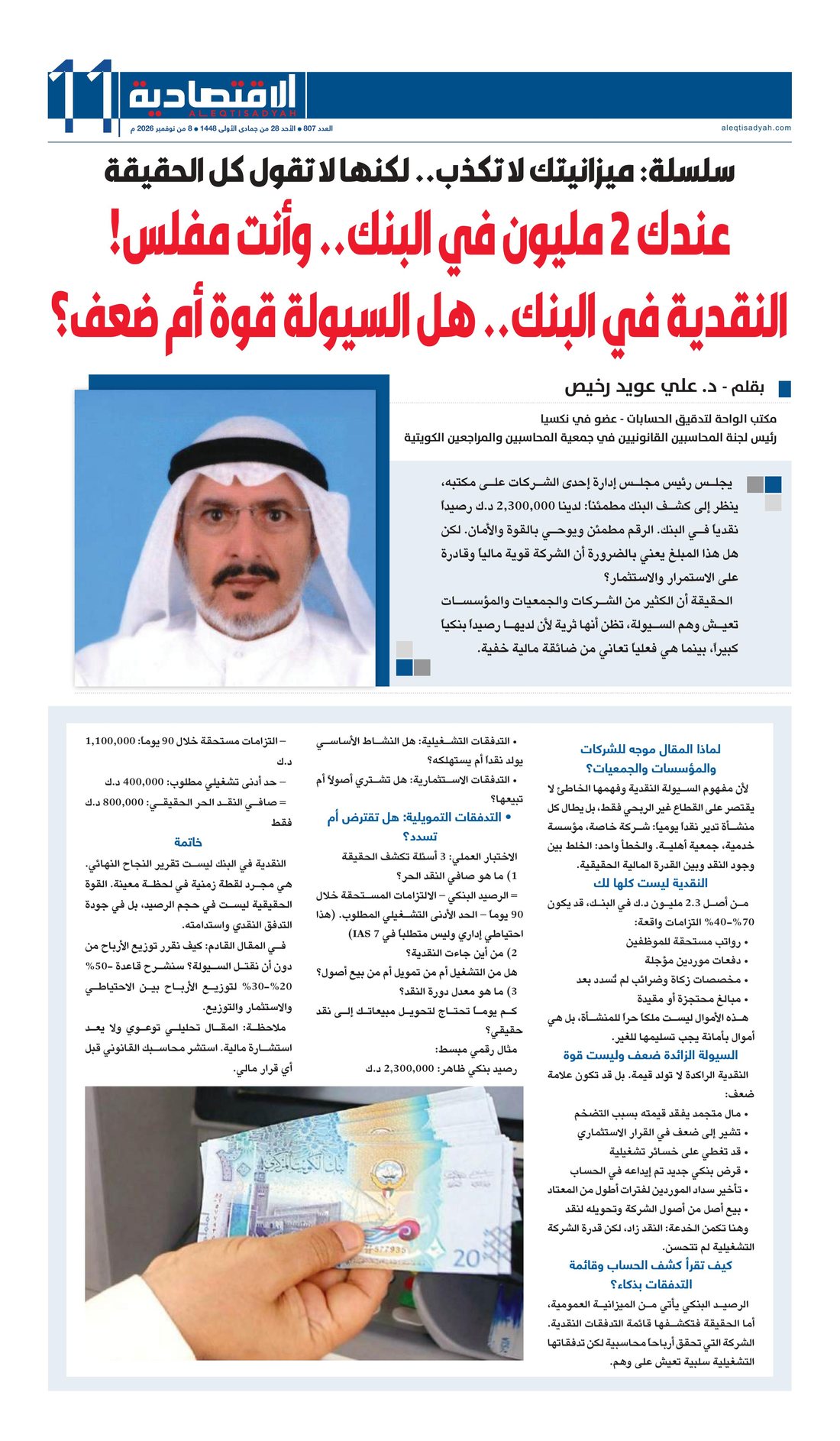


The chairman of a company sits at his desk, looking at the bank statement with reassurance: we have KD 2,300,000 in cash at the bank. The figure is reassuring and suggests strength and security. But does this amount necessarily mean the company is financially strong and able to continue and invest?
The truth is that many companies, co-operative societies and institutions live under an illusion of liquidity: they think they are wealthy because they have a large bank balance, while in reality they are suffering from a hidden financial squeeze.
Why is this article aimed at companies, institutions and societies?
Because the concept of cash liquidity, and the misunderstanding of it, is not limited to the non-profit sector; it affects every entity that manages cash daily: a private company, a service institution, a civil society. And the mistake is the same: confusing having cash with real financial capacity.
Not all the cash is yours
Of the KD 2.3 million in the bank, 40% to 70% may be existing obligations:
- Salaries due to employees
- Deferred supplier payments
- Zakat and tax provisions not yet paid
- Withheld or restricted amounts
This money is not freely owned by the entity; it is money held in trust that must be handed over to others.
Excess liquidity is a weakness, not a strength
Idle cash does not create value; it may even be a sign of weakness:
- Frozen money losing value to inflation
- A sign of weak investment decisions
- It may be covering up operating losses
- A new bank loan deposited into the account
- Paying suppliers later than usual
- Selling one of the company's assets and turning it into cash
This is where the trick lies: cash went up, but the company's operating capacity did not improve.
How to read the bank statement and the cash flow statement wisely
The bank balance comes from the balance sheet, but the truth is revealed by the statement of cash flows. A company that makes accounting profits but has negative operating cash flows is living an illusion.
- Operating cash flows: does the core business generate cash or consume it?
- Investing cash flows: are you buying assets or selling them?
- Financing cash flows: are you borrowing or repaying?
The practical test: 3 questions that reveal the truth
1) What is the net free cash?
= Bank balance − obligations due within 90 days − the minimum operating cash required. (This is a management buffer, not an IAS 7 requirement.)
2) Where did the cash come from?
From operations, from financing, or from selling assets?
3) What is the cash conversion cycle?
How many days do you need to turn your sales into real cash?
A simple numerical example: Reported bank balance: KD 2,300,000
- − Obligations due within 90 days: KD 1,100,000
- − Minimum operating cash required: KD 400,000
- = Real net free cash: only KD 800,000
Conclusion
Cash in the bank is not the final report card. It is just a snapshot at a particular moment. Real strength lies not in the size of the balance, but in the quality and sustainability of cash flow.
Note: this article is an analytical, awareness piece and is not financial advice. Consult your chartered accountant before any financial decision.